

I’m not sure if this post is about optimism or about hope. I’m not sure I even know the difference. And I certainly don’t know what these terms mean in a 21st century context.
Not knowing is a good place to start. I might end up there too.
I’ll tackle hope first. Webster says: “to desire with expectation of obtainment or fulfillment.” So, there’s no hoping without wanting some outcome, but there’s this other element too — the belief that it’s obtainable. When we hope, as opposed to despair, we are oriented in favor of fulfillment.
How much do we need to expect our favored outcome? I’m thinking it doesn’t take a lot to tip the balance. Hope is an orientation to the future, an attitude. Let’s say that when we hope, we’re 51% bullish.
How about optimism? Webster says: “an inclination to put the most favorable construction upon actions and events or to anticipate the best possible outcome.” Maybe there’s an element of optimism implicit in hope, then, but on it’s own, it implies greater certainty. I can’t help but think of Voltaire’s Candide: “all is for the best in the best of all possible worlds.”
Voltaire was a satirist.
Indeed, optimism feels like a stretch in the face of Armageddon. I just looked up Armageddon too: “the site or time of a final and conclusive battle between the forces of good and evil.” Sounds about right.
And yet, destruction can be an agent of opportunity. Old systems break down, leaving a vacuum that could, hypothetically, be filled by new, more equitable systems. Perhaps a broken world is easier to fix.
We are litigating the arc of humanity itself, and the jury is still out. Will greed, narrow self-interest, tribalism, fear, and ignorance prevail? Or can the pressures of these times forge in us qualities that foster the preservation, not just of our own kind, but of this precious world we share with a staggering abundance of lifeforms.
It’s easy to despair. Each day, I open my laptop on a new crop of disasters. Rogue computers, climate catastrophe, authoritarianism, war, famine, recession, habitat destruction, ocean acidification — take your pick.
So what does hope, let alone optimism, mean in the face of the apocalypse-of-the-day? How do we walk that line between hope and willful ignorance, between realism and despair? How to be realistic but not fatalistic? To take meaningful action when meaning has all but broken down?
It’s the conversation we’re all having, one way or another. My husband and I are big fans of live theater, and recently I saw my first play in the legendary West End, which has something to say about the question at hand.
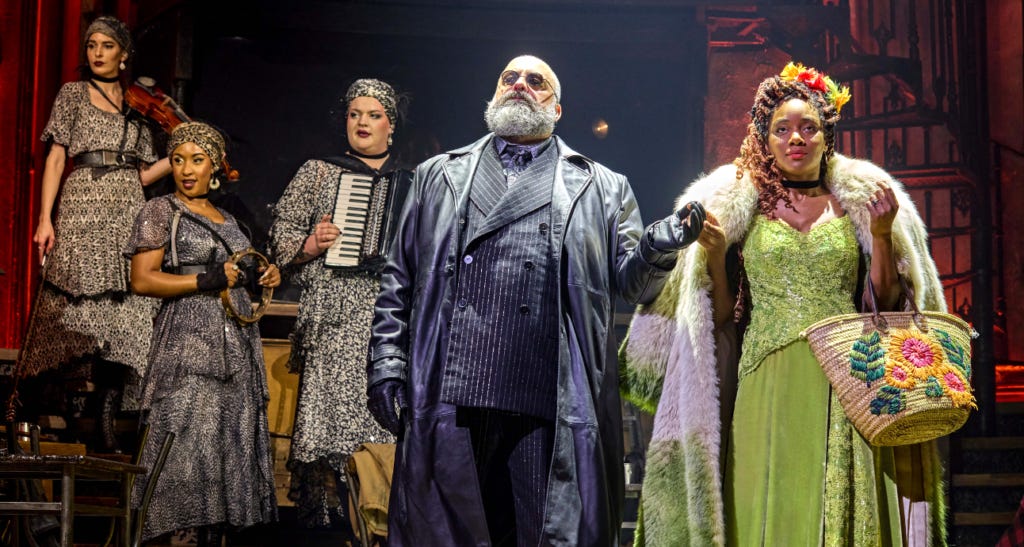
Hadestown at London’s Lyric Theater
I could write a whole post about how good Hadestown was, and I still wouldn’t be able to do it justice. Let’s just say the play’s eight Tony Awards and the Grammy are well deserved. Clive Rowe in the role of Hermes was phenomenal, as was Rachel Adedeji as Persephone and Alastair Parker as Hades. But to single them out would be to slight the rest of the extraordinary cast.
It’s the old, Greek story of Orpheus and Eurydice, reimagined against the backdrop of a mining town that could as easily be in the coal fields of England as Appalachia. The play hits all the modern marks, from weather gone mad to corporate greed to irrational consumption. It is both classic and astonishingly timely.
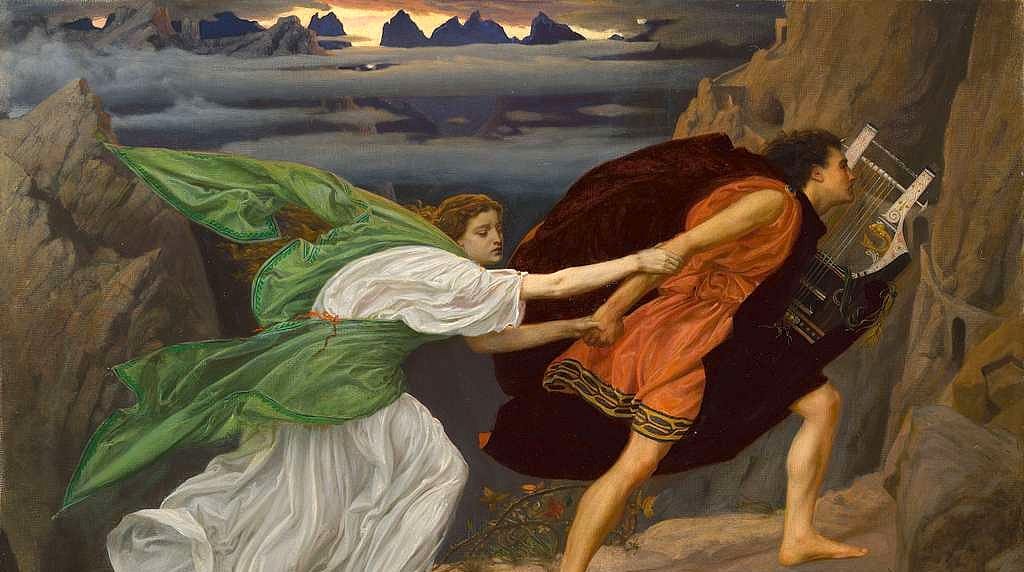
Most of us know how the original myth goes. Orpheus goes down to the underworld to rescue his love, Eurydice. Orpheus is blessed with the gift of song, and he sings one for Hades that is so true, so real that even the lord of the underworld is undone. Returned to love. Returned to himself.
This is what a true song can do.
So, Orpheus sings his way out of hell, only to suffer a crisis of faith of the cusp of freedom. Hades has imposed one condition on their safe passage — Orpheus must never look back to see whether Eurydice is following. All through the long, black hours, he must trust that Hades has kept his word. And truly, what does he have to lose? If he looks back to test Hades’ good faith — she will be lost to him anyway. The facts are so inarguable, the way so clearly defined, it stretches credulity that Orpheus will fail.
And yet, he does.
And it is credible because — look at us. When faced with clear evidence of self-destruction, we simply aren’t capable of making rational decisions. And not just en masse. I can’t seem to stop shopping at Amazon. I can’t even remember to bring my reusable bags to the grocery store.
It’s also a story about faith, which by nature does not rest on verifiable premises. And how do we act in the face of the unknowable? To what do we adhere? It’s a story of obedience, of Adam and Eve in the garden and that one damn apple. It spans cultures and traditions, and in many respects it’s the first story, and seems to go right to the heart of the tragic, flawed, idiotic beauty of being human.
So, we know what’s coming.
Don’t ask why, brother, don’t ask how
He could have come so close
The song was written long ago
Resonance is one of my favorite analog values. Resonance amplifies, enriches and intensifies an existing tone by adding vibrations. It requires an original backdrop to achieve new expression. I like to think it’s why music played on vinyl will always sound warmer, deeper, and more alive than that played on a compact disc.
We know that Orpheus will look back, literally seconds before he enters the light at the end of the tunnel, and this resonance has me squirming in my seat, hoping the play will depart from the tale, but knowing it cannot. What tale will it tell then? How will this spectacular betrayal of hope be framed? And in the aftermath of categorical defeat, what will be said.
It’s a sad song
But we sing it anyway
‘Cause here’s the thing
To know how it ends
And still begin to sing it again
As if it might turn out this time
I learned that from a friend of mine
Those are the words, but what do they mean? That human beings are divorced from reality, hopelessly doomed to act out past failures, incapable of devising new endings for old, self-defeating tales? Maybe. But I think the actual message is more fundamental, and more subtle. And I think it’s something along these lines:
The human spirit is not dependent upon outcomes.
We try again, even knowing how it turned out, how it turns out. We will be trying right up to the end, if there is one.
The human spirit is not dependent on outcomes. The statement itself is ambiguous. It does not promise that we are capable of transcending our worst impulses. Perhaps we are doomed like Orpheus to annihilate what we cherish most through a failure of reason, faith, and action.
It does tell us something structural about the spirit animating our humanity, though. This spirit is not determined by the world of living and dying, of creating great art and perpetrating atrocities, of smiling at babies, and taking one’s own life. Our animating spirit contains all these complexities and contradictions, and yet is not defined by them. It is contextual. It adheres to itself.
It tells us about our essential nature, even if it doesn’t give false assurances about the future. Karma unfolds in a mysterious dance. Past conditions create future outcomes. Our actions have consequences, and to believe otherwise is magical thinking. Our collective future will be absolutely consistent with our collective actions. The onus remains on us.
And yet, there is something real here, something to validate and rely upon. We extricate ourselves from the wreckage of past failures, spectacular in their carnage and scope, and once again, we raise our voice. What tale will we sing? What tale will I sing, even when I know how the last song ended?
Yes, we are Orpheus. We fall prey to fear and doubt, and this causes us to act irrationally. But the tale begins again —and again, and again. What are we if not a tale unfolding? We are both the singer and the sung, and we can no more help this than we can help drawing breath.
How does this help us? I consider it to be a call back to the present moment, which is the only time in which we actually exist. Past, present, and future conditions are constantly in motion, and they have their own physics. But the quality of the present moment, like the human spirit, is not dependent upon circumstance.
When we fall prey, like Orpheus, to doubts and fears about what we will find at the end of our long, dark sojourn, it is good to remember that these are phantoms of our minds that will lead us astray. If Orpheus loses his one, true love, what do we lose when we fail to experience the treasures we possess for fear of what may one day come to pass? To cherish this moment in its fullness is not the same as hiding one’s head in the sand. It doesn’t insulate us from accountability. It’s an exercise in discrimination.
It is also a call to own our song. We cannot help but sing our lives, even if they’re tales of death and failure and woe. But each day, we begin a new song. And that song is the story, not of the future, but of the present moment, where we live. If you look, if you pay attention, you will see that this is true.
We sing in the face of cruelty and greed and hatred. We sing even though we don’t know how the song ends. Like beads on a string, if we attend to the song of each day, who knows what world might emerge from the tangled chords? It will surely be a different world than that which is forged from fear and avarice and doubt. And at the very least, our moments will have passed in the light, and our songs will have been of our own choosing.
So, hey, if someone accuses you of being a Pollyanna just because you have the temerity to hope, you’re in good company. My response would be — why not?
Is this a way to think of optimism, then, as a song sung for the moment you’re in? The 21st century can feel like the harbinger of unprecedented times, and it is. But it’s also an old, old song. And somehow, weirdly, that brings me comfort. We stand, shoulder through shoulder through the ages, singing our idiot song. But the singing itself has its own nature and reality, quite apart from the song. Perhaps it will all be snatched away, right at the end, just when we think we’re through the worst. One bad choice too many, and the whole thing goes.
But who knows — maybe, if we keep attending to the song, moment by moment, some day, we’ll get the ending right.
Photo attributions: orpheus and eurydice a painting by edward poynter, public domain; photo gallery, https://thelyrictheatre.co.uk/tickets/hadestown/