

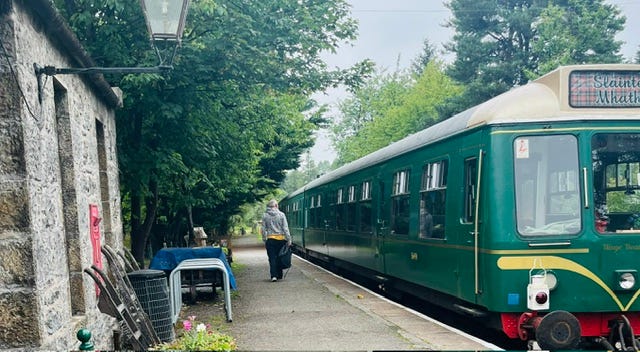
Going Away and Coming Home
Do you remember your first book?
This is a variant of that age-old question about your first love. For me, it was Little House in the Big Woods, followed by the entire Little House series. I was seven years old at the time, living in San Francisco during a time of upheaval for my itinerant family, and I can still recall the dawning of wonder and comfort, the epiphany that I could, at will, enter a new world – a place of adventure, but also one of refuge, set apart from all the vulnerability and change of my real life.
Was I going away or coming home as I stepped across the threshold of that house that Pa had built with his own hands? The answer, of course, is both.
Astonishingly, this new superpower was always within my reach. No matter where I went, or what difficulties awaited me – I could always enter a book. The covers of beloved ones were old friends, but others hinted at relationships I had yet to encounter. I would come home from the library and lay my armload of books out on the floor, trying to decide which to read first, each cover shimmering with possibility.
No adult can read quite like a child reads.
And yet, the whiff of magic endures. This paradoxical sense of going away and yet coming home is central to the fiction experience, no matter your age. All novels are “fantasies,” not just because they are “made up,” but also due to the peculiar quality of adventure and homecoming that the activity of entering a story evokes. But I think the genre of fantasy literature distills this quality into its purest form. Fantasy worlds are obviously (and sometimes lavishly) invented, and so often the plots involve quests and journeys and, at the end of it all, homecomings.
When Gandalf knocks at Bilbo’s door with his wizard’s staff, and the dwarves follow by twos and threes, casting shadows on the walls of his hobbit hole that are fraught with strangeness, we feel the call of the unknown, but we are also touched by a far more distant shadow, a longing for the homecoming that lies at the end of a journey not yet begun. And it is only in leaving the comfort of his hobbit hole that Bilbo can ever experience the poignancy of that beloved return. The journey itself is part of the homecoming.
Which makes me wonder – are we always simply journeying homeward?
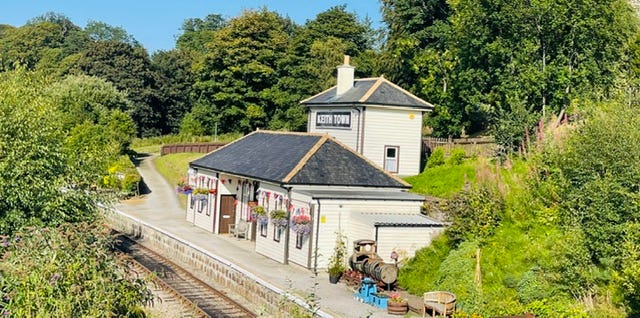
All Aboard
All this came to my mind when I spied the darling little Keith-Dufftown train depot, looking much as it must have back in its 19th century heyday. We stood on the platform as the train shuddered into the station amid the cries of the conductor and the scream of the whistle. The line still runs on weekends, for tourists like us, and the conductor plays his part. But we know that we can never actually enter the past. We are – all of us – bounded in time and can no more extricate ourselves than we can stop the passage of time itself.
Nostalgia is the yearning to return to pasts both real and imagined, but this homecoming is impossible, and it is this that gives nostalgia an emotional resonance of longing, wistfulness, and thwarted love. Perhaps it is that quality which reminded me of the books of my youth, as much as the fairytale setting. Journeys of the imagination will always be just that – imaginary. And therefore, they will always be imbued with nostalgia.
Context and content arise together as an inextricable whole. We must go away in order to come home, and so how can we separate the journey from the homecoming? In a similar way, at the moment of our birth, our death arises as well. This too is a journey and a homecoming. The space between birth and death is marked by time, passing with all the appearance of a linear progression, day to day, year to year. Yet, in some sense, we are simply living out a drama that is already written, if not in its contours, at least in its conclusion. And this largely subconscious awareness of being bounded in time is fundamental to the human experience.
Nostalgia whispers of these mysteries to us from the deepest strata of our being, mirroring our essential nature. That’s why the longing cuts so deep.
There’s more to say here, for limitation is such a foundational, paradoxical, and as it turns out, bountiful subject, that it could fill a book (and maybe it will). Turning towards, investigating, and eventually embracing the structural limitations inherent in our nature and reality gives us access to, well, our nature and reality. It like that old joke about who’s buried in Grant’s tomb. Yet so often, we attempt to hide from that truth, both as individuals and as cultures – to thwart it, forestall it, or overcome it. These efforts are, of course, doomed to failure, but more importantly, they rob us of a complex sense of reunion with ourselves, and the power, resourcefulness, and peace of mind that such a reunion makes available.

I said I’d keep it (kind of) short, so I’ll leave you with nostalgia for today. We’re heading to London as I write this on another train – a modern one with all the conveniences. And in a few days we’ll be flying back to the states, to the place I call home, at least for the time being. But I’ll be unpacking the analog treasures of our trip to Scotland for the next few weeks, so stay tuned, and as always, I’d love to hear your thoughts.
As always when I journey with you, I find pleasure and joy traveling with someone who looks and feels so deeply and of course writes so beautifully. Thanks!