

I first read Austen as a 15-year-old when Pride and Prejudice was assigned to my high school English class. I took it on a family trip to the wild, Oregon coast and spent most of a day on the sofa of our rented cabin instead of braving the frigid waters, finishing the book in one marathon session. Of course, I was captured by the romance, but I have vivid memories of being equally captivated by the repartee. Here was a sense of newness, an introduction to an intricacy I had never experienced, a window into a time when words and wit were considered to be an art, both indicative of, and obstructive to, what I now would call character.
I’m rereading all of Austen’s works — five down, one to go. And it is this illumination of character, of what defines a quality human being, that now strikes me as the main preoccupation of Austen’s work. Her subtle, lawyerly distinctions investigate the society in which she lived, but also articulate a nuanced personal canon of values that is developed over the course of her short, productive literary life.
Catherine Morland: the anti-heroine
Northanger Abbey was the first novel Austen wrote, but it was the last to be published, after her death. From the first sentence, we are given Catherine Morland as an anti-heroine, the perfect foil to lampoon the Gothic Romantic tradition that was all the rage in Austen’s time. But in making Catherine profoundly average in every respect of appearance, talent, and capacity, we are also being positioned to explore the very nature of human worth. Does it lie in beauty, deportment, and accomplishment? And when you peel these attributes away, what is there?
I love the mischief and humor in the opening passage as Austen sports with the excesses of Gothic literature:
No one who had ever seen Catherine Morland in her infancy would have supposed her born to be an heroine. Her situation in life, the character of her father and mother, her own person and disposition, were all equally against her. Her father was a clergyman, without being neglected, or poor, and a very respectable man, though his name was Richard—and he had never been handsome. He had a considerable independence besides two good livings—and he was not in the least addicted to locking up his daughters.
This continues in kind through all of Catherine’s formative years, painting the portrait of an unremarkable young woman by the feminine standards of society, raised in the bosom of a large, good-natured, and uncomplicated family. And yet, in Chapter Two, we are given a hint as to what lies beneath this disappointing veneer, an affectionate heart, and a “disposition cheerful and open, without conceit or affectation of any kind.”
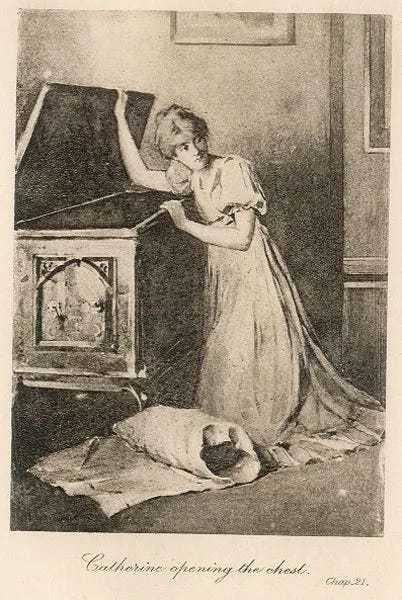
It is not surprising that these qualities are an appealing combination for the inevitable romantic interest, Mr. Tilney, but it is something more substantial that ultimately wins his heart. Catherine’s absence of affection and earnestness of heart are symptoms of a deeper integrity, an authentic self that, even in all of her youthful confusion, never wavers as she is tested, time and again, without even being aware of the test or the vindication.
Being without pretense, she cannot help but take others at face value. She is blind to the manipulative arts of her new friend, Isabelle Thorpe, and the self-serving deviousness of Isabelle’s brother, John. And yet, even as Catherine’s guileless nature blinds her, it protects her too. Her instincts for what is proper and right — at a human level, not societal — never falter. She is intact, whole, and this integrity cannot ultimately be compromised by all the machinations of those who would use her, even as she never fully comprehends that which has protected her. She is a naive heroine, and by definition any consciousness of her virtue would be antithetical, would not so much destroy that virtue as be symptomatic of its effectuated destruction.
Integrity and substance are analog values, and I am reminded that the distinction between substance and artifice is human, not just technological — although our digital capacities have magnified both the means and consequences of artifice in unprecedented ways. And the ultimate message that Austen gives us is startling in it’s simplicity: that the integrity of an honest disposition can not be compromised by external pressures. It can only be abandoned, never defeated.
Why does this matter, almost a quarter of a millennia after Austen penned these words? For one, it reminds us that there is nothing new about the attempt to manipulate truth to one’s advantage. Yes, digital capacities have turbo-charged distortion. But society has always elevated appearance over substance, credentials over worth, has always been a wilderness in which those without protection can lose their way — and more poignantly, lose their way back to the authentic self. I think Catherine may be one of my favorite Austen heroines precisely because her virtue is unconscious, not cultivated through effort or design, but rather strengthened organically through practice as the world tests her.
What can we give Catherine credit for? Perhaps it is her unwillingness to part with her intimate self, even amidst the pressures and confusions of a duplicitous world — although I don’t think she is even capable of such a departure. She listens to her inner voice, not with intention or even awareness, which would itself be the exercise of a kind of artifice, an attempt to be good rather than simply being so. Catherine wins in the end by being herself, and I think this is one of the most powerful and revolutionary messages we can carry into the digital era. Perhaps who we are — as distinct from our attributes, our successes, our physical appearance, our resume — who we simply are is not only enough, it is everything.
I invite you to join me on my Austen reading spree! Next up is Mansfield Park for a different take on authentic virtue. Read up, and if you’re already an Austen nerd, I’d love to hear your thoughts.