

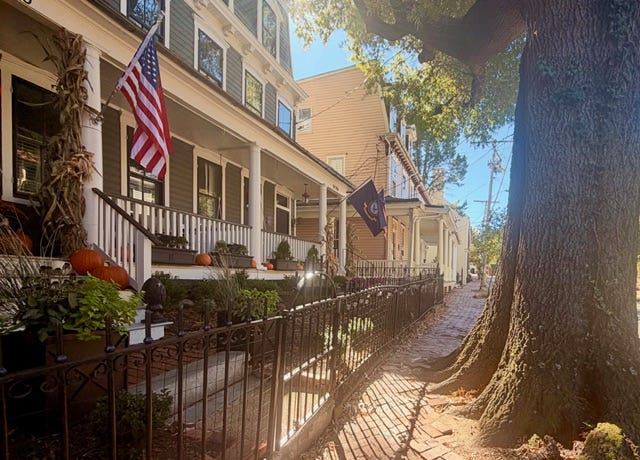
I’m in Annapolis, MD this week, as I am every late October in recent years, attending the annual sail boat show.
I love Annapolis.
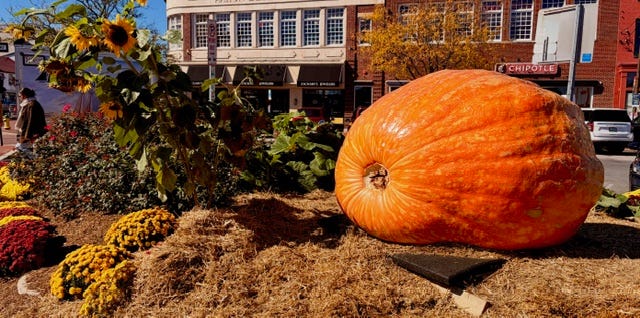
I am a creature of tall, shuttered, wood-clad houses, their narrow backyards lost in filtered gloom beneath leafy canopies, and twisting byways paved in red brick, crumpling over the roots of encroaching sycamores. The thicket of masts down the hill at the docks sways like a forest of striplings against a crisp, autumn sky. Giant pumpkins squat on street corners, nestled in a cornucopia worthy of some halcyon harvest festival — that first Thanksgiving, which as it turns out is a nineteenth-century construct, fashioned by a young country in search of a mythology.
In search of heritage.
For anyone who loves the past, Annapolis is pure magic. It’s not quite my heritage, but still strums some deep chord in my memory. It’s the story we were given throughout my 1970s elementary education as we traced the contours of maple leaves with crayons, fashioned pilgrim hats with buckles from construction paper: a New England on the cusp of fall and a fleeting gesture of friendship between one people destined for annihilation and another who were to be the heralds, and agents, of that destruction. And though we didn’t talk about it as a fulcrum moment, I think I felt the poignancy of it even then, a whiff of sorrow lurking around the edges as I contemplated a vanished people, laying down arms to break bread with the strange race of white-faced newcomers who hunkered down, fearing the wilderness beyond their palisades.
We are not a nation steeped in millennia of lore and custom, rooted in our native soil. This is fact, no matter what fictions we cobble together to substantiate our claims. We are weeds, in all our chaotic beauty, taking root in someone else’s garden, tenacious, opportunistic. In the grand accounting of civilizational time, we Americans are wayfarers, importing the traditions of our ancestral homelands to a new place, only to see them crosspollinate with the native flora, with other wild breeds, to create something new. Diversity, then, must be our strength, must, in fact, be in the very DNA of the our national heritage, with all the dynamic, adaptable, hybrid-vigor of our mongrel breed.
I am reminded that some of us came to the new world against our will. The Museum of Historical Annapolis tells the story of enslaved Africans, sold from the decks of a thriving sea port. The story of race seems especially complex in this tobacco-producing state straddling north and south, which sided with the Union, but just barely. Since its founding, a third of the Annapolis population has been African American, a few of whom were already buying their freedom, owning property, founding churches, and leading communities as early as the revolution. It’s a proud but painful narrative, transformative, fraught with contradictions that are still unfolding today.
What do we think of a heritage that contains acts of both courage and atrocity? And when the voices that comprise a nation’s heritage are so varied, and so many, what do we make of that heritage as a whole?
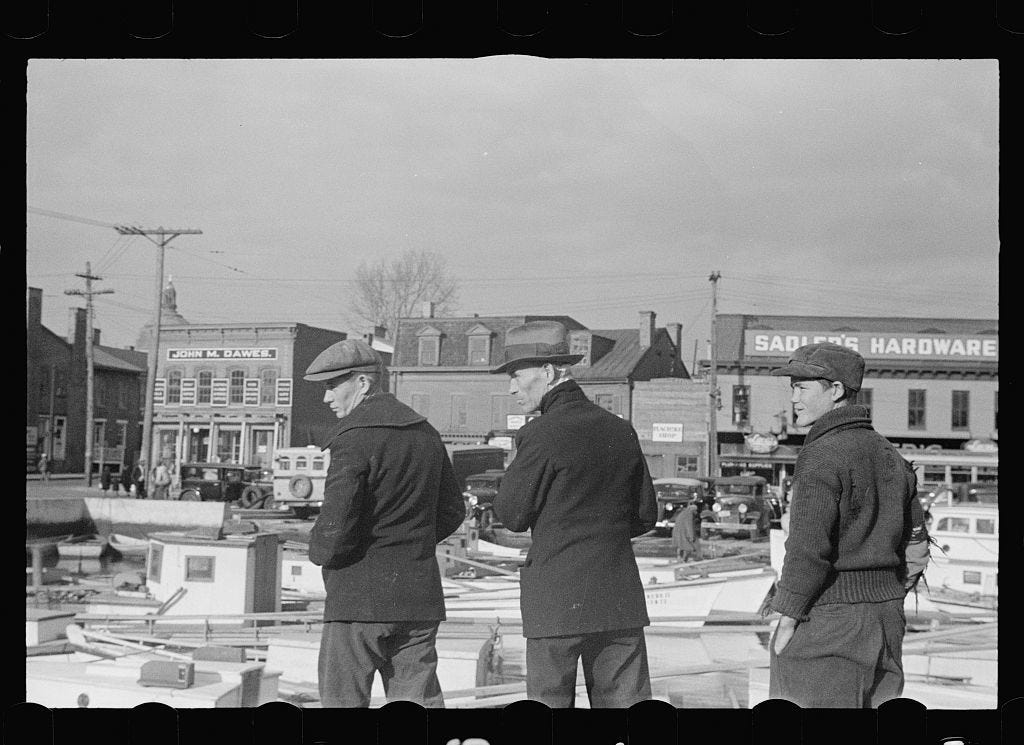
Photo attribution: A black and white photo of three men in uniform, Great Depression, FSA/OWI Photograph, Library of Congress.
My forbears came later, during the mid-to-late 1800s. My German ancestors, on both sides of the family tree, were well-rooted in Bavaria for centuries until hardship drove them seaward, but my Swedish, maternal great-great (and maybe another great?) grandfather headed first to Norway, in search of work to support the family he had left behind. My Irish, paternal great-grandfather was one of twelve siblings, some of whom suffered the kind of tragic, premature deaths that were common among the working class. Like many Americans, the motivating impulse of my heritage seems to have been largely born of hardship and necessity, perhaps more imperative than aspirational.
Indiana is my homeland, at least dating from the late 1800s, except that it’s not because my parents left for the west when I was nine and have never really looked back. Most of my kin for the last hundred years have remained in the Indianapolis area, so perhaps my parents sprouted a new branch of the family tree in the fertile Willamette Valley of Oregon, and that gives me some sense of kinship with those who ventured westward in covered wagons. Our journey was made in a Honda Civic, the really tiny ones that didn’t survive the 70s, and although we suffered forms of privation, I’ve really no claim to kinship with those hardscrabble pioneers, except in being drawn by the mystique of the west — the wide-open spaces, the fluidity of norms that characterizes a transient population.
I wonder, then, what is our heritage as Americans? Is it like a quilt, a patchwork of traditions, norms, and sensibilities, imported from the myriad lands of our ancestors? Is it a canon of values forged by the act of pilgrimage itself? Is it a sense of identity encoded in our form of government, an ideal envisioned first as a “city on a hill,” then later as Lady Liberty’s torch, enshrined in a working constitution that has weathered a quarter of a millennia?
It’s a good question, and like all good questions, I hope it is never definitely answered, although perhaps this contradicts the idea of “heritage” as something fixed, something that can be passed down as easily as the family china. Can heritage be considered a living thing, an emergent tradition, capable of uniting without excluding? Perhaps, because of our youth as a nation, because of our continued evolution as a nation of immigrants, we are uniquely qualified to investigate this possibility, and to bear its standard into a world that is shrinking by the day, with all the crisis that entails. Messy as our country is, I’d like to think so.
What do you consider to be your heritage? I’d love to hear from you in the comments below.
I love this post! Thank you for taking me to all these places in our American story.