

For the last three years, I’ve been flailing around, trying to write one thing or another, a frustrating experience on the heels of writing a book a year for four years straight. Chalk it up to my phase of life, with a dash of creative reboot thrown in. A few weeks ago, I shared the first chapter of an old project with y’all, Aracana, which I think it shows promise. But as I finally settle down to WRITE SOMETHING, I’ve realized I’m called to finish what I started — before I finish what I started before I started the thing that needs finishing.
Welcome to my world.
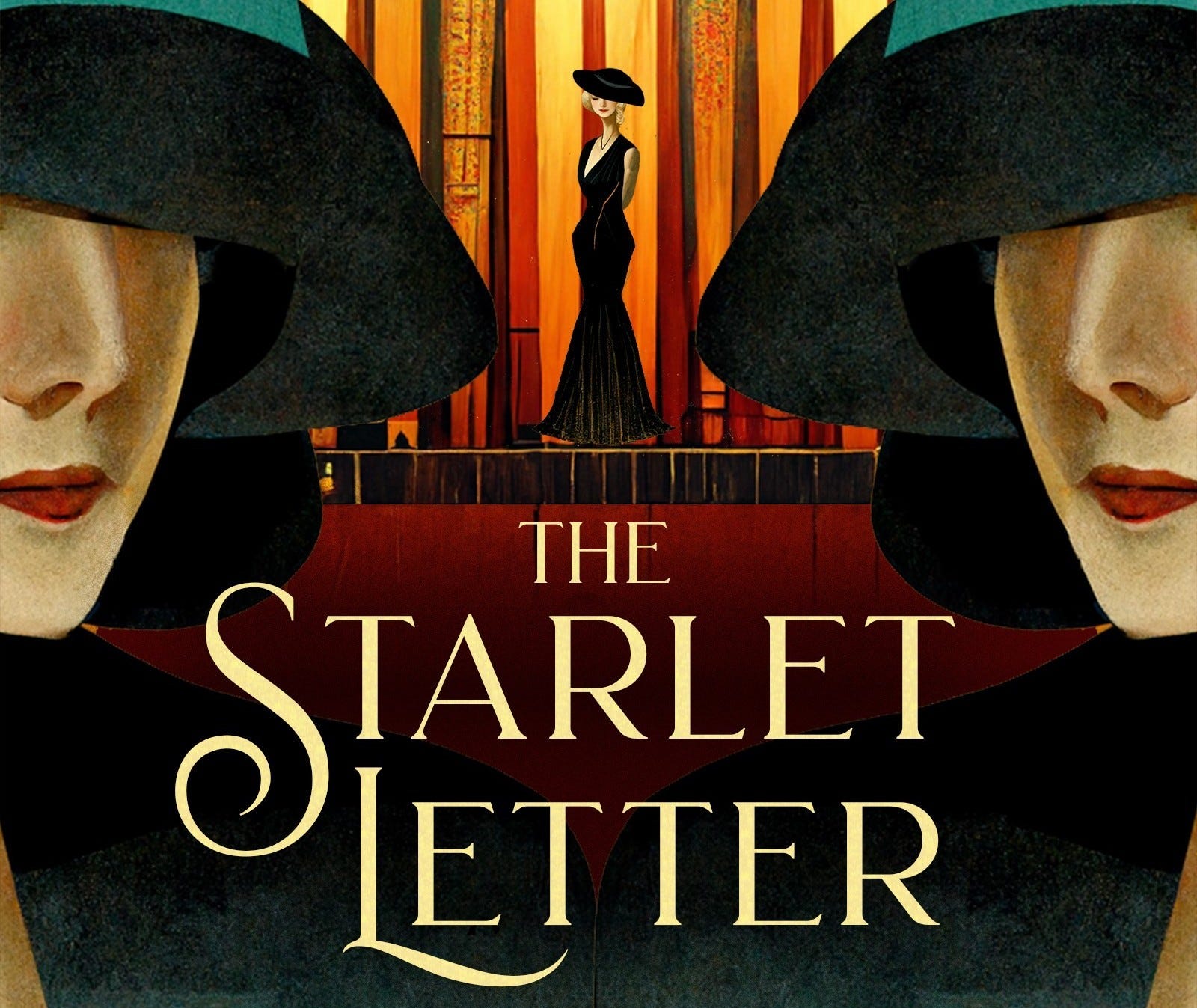
Some of you have read and enjoyed The Starlet Letter, a tongue-in-cheek mystery set in 1931 in New York City, and featuring twin female sleuths, coming of age in a declining aristocratic household that has taken in boarders, whose antics invariably lead to intrigue. It’s Book One in my Canary House Mysteries series, each installment of which features a classic work of American literature at its heart.
Book One was a Foreword Indies Finalist, a National Indies Excellence Award Finalist, and snagged a Writer’s Digest honorable mention. It has garnered a small but loyal following that I hope to grow. I’ve decided to finish the intended five book series — or at least give it the solid three books that it deserves.
Book Two will center on The Last of the Mohicans, by James Fenimore Cooper, exploring themes of dispossession. My working title is The Past of the Mohicans, but I’m taking suggestions!
To celebrate this decision, and to bring those of you unacquainted with the series into the fold, I’m running a free book promotion on The Starlet Letter. Between 11/3 and 11/7 you can claim your free copy HERE.
Here’s chapter one of The Starlet Letter to whet your appetite, and I look forward to posting some chapters of Book Two, soliciting feedback and beta readers, and sharing progress with everyone in the coming months.
And if you know someone who enjoys witty cozy mysteries with a literary bent, please share! The free book promo is available to all through Amazon.
Chapter I
Enter the Seven
The Van der Beecks had always been considered slightly disreputable in New York Society. Oh, sure, they were of solid Knickerbocker stock, going back to the days when the city had been called New Amsterdam and Wall Street was just a wall. Johann Van der Beeck, the twins’ great-great-great-great-great-grandfather, had arrived in 1642 to set up a windmill and had later been named a Great Burgher, and after that, various Van der Beecks had made and lost fortunes in beaver pelts, banking, and the odd misadventure into real estate. That’s what people did, after all, and by people, one meant the Old Guard. And yet it was the family’s fate to be always like that child quietly forgotten when introductions were made.
For they were unmistakably different.
Take the ancestral home at 63 Central Park West. All the right people lived on the Upper East Side where you never stayed out past dark and the talk at dinner parties was of horses and yachts and what had happened at Newport. And if you ever had an interesting thought in your head, you mustn’t let it show, for Fifth Avenue was comme il faut, how things were done. Now, the Upper West Side—well, there were theaters and concert halls and other vulgar entertainments that went on well past midnight, and you might even see a revolutionary stumbling home late, singing ballads about the world to come.
Grampy Cornelius had built Canary House, as it was called, back before the Great Crash and even before the Great War, back when Central Park was just a muddy field and there was nothing to look out on but pig farmers, chicken wire, and a small house or two. The design had come to him in a dream—half château, half Kremlin—with plenty of gables, turrets, pinnacles and peaks, and a few domes thrown in for good measure. Father and his brothers had been born there, and it was not until 1909 that Grampy took up with a traveling mystic and left for India, never to be seen again.
The Van der Beecks had a talent for disappearing.
It was all there in the diary, a centuries-old volume cataloging the unusual, unwholesome, and untimely deaths, the ill-fated expeditions and ill-advised marriages, and a general habit of absconding with entirely the wrong sort.
“It must be to do with the curse,” Viola said as she nestled beside her sister in the bay window, leafing through the journal’s tattered pages.
“Oh, not that old rot,” Vivian said. “People make their own rotten luck. You know, Lala, you really ought to stop reading those horrid Gothic novels.”
“That’s not all I read!” she cried. And it was quite true that Viola had memorized nearly half the books in the family library, if you can call it memorization when something just sticks in your head.
Vivian and Viola had been born over seventeen years before on the very same day, at almost the same time, as most twins are. They were identical, only they were opposites too. Vivian was possessed of a preternatural gift for persuasion. She enjoyed pulling the wool over the eyes of mere mortals, and she prided herself on living in the real world, whereas Viola liked rummaging around inside of books and only came out because she couldn’t bear to be without her twin. They had the same fine blond hair pulled back from a high forehead and heart-shaped face, the same striking gray eyes smudged mauve somehow about the lid in a way that was strangely becoming. They were long-limbed and wispy with knees that bowed slightly back, and the only difference in their appearance was that Viola sometimes wore glasses.
Strangers always looked at them twice.
Truth be told, they had their mother’s looks, who was French by birth and educated in Egypt and whom everyone in Society envied and no one liked. Gisele cared not a whit. “Let them eat cake,” she would sometimes joke, and while Vivian would applaud and Viola would search her mother’s eyes for hidden sorrows, to all the world it appeared that Gisele was a world unto herself. Father was a trickier specimen. Viola was certain he had suffered badly in the war, for even Mrs. Lurch said he’d come back changed, but James Van der Beeck—Jimmie to his friends—was cheerful to a fault and reckless too, and it seemed that with him each day was made to be squandered.
Other than that, there was only Great Auntie Lavinia.
For the sad truth of the Van der Beeck lineage was that by the year 1931, with the Depression on and the world reeling from a decade of excess followed by a very Black Tuesday, there were only five twigs left on the family tree. The day the stock market crashed, two Van der Beeck uncles followed suit, plunging to their deaths from the rooftop of an eighteen-story building—the most lamentable suicides ever to be cataloged into the diary. The stocks and bonds were worthless, the estate in the Hamptons sold for creditors, and all that remained was Canary House with no means to support it.
“If we’re under a curse,” Vivian continued, “then why all our good luck?” And she didn’t need to explain herself because she and Viola shared one brain, a meta-brain Vivian had coined it (after hearing a lecture on quantum physics), invisible yet somehow connecting their synapses so that everything one twin said the other understood at once.
“I suppose you’re right,” Viola agreed. “Think of it! We never would have met Mr. Sparrow!”
“Nor heard his tortured ruminations at the piano late into the night,” Vivian said, sounding much more like her sister than herself. She only waxed poetic for Mr. Sparrow.
“And think of Miss Sphinx!”
“And Mr. Sharma!”
And before they knew it, they’d reminisced their way through all the tenants who would never have come into their lives had the Van der Beecks not been forced to make ends meet.
“Canary House must be the most interesting boarding house in the history of the world,” Viola sighed, and for once, her sister did not correct her excesses. All toted up together, the house boasted six tenants: a pianist, a poet, an erstwhile diplomat, a psychiatrist, a bootlegger, and a philanthropist who was always short on cash. There was a vacant room in one of the turrets, but whosoever took up lodgings there did not stay long.
And they say that seven is a lucky number.
But luck and calamity are often mixed, and seven had secrets to tell. When Grampy Cornelius wandered into China after seven years spent levitating with a Hindu fakir, he’d learned those secrets the hard way. For in the Book of Changes, seven is a yang number, an active number, its pronunciation much like that of the word meaning gone, and it is used to release dead souls from purgatory.
Words are power, and power is fate, and the twins’ ecstatic declaration had not gone unheard by the powers that be. For although it seemed the Canary House could not be even one iota more interesting than it already was, someone was already walking up the winding path to the door under the glow of a streetlight, stumbling and straightening as she broke her heel.
Babs Le Roy rang the bell.